
4News
Location: Home ->  News
2025
-
11
-
19
The core of the refined management of non-standard parts production lies in making the seemingly chaotic customized production controllable, efficient and transparent through systematic methods. This requires you to carry out systematic optimization from multiple dimensions such as processes, data, technology and personnel
2025
-
09
-
04
The external cylindrical turning process for lathe-machined parts involves rotating the workpiece via the lathe spindle while coordinating axial feed motion of the cutting tool to remove excess material from the workpiece's outer surface. This achieves the desired dimensions and surface finish. The core process comprises three stages: rough turning, semi-finish turning, and finish turning. Technical parameters and tool selection for each stage must strictly align with machining requirements. Specific process flow and technical points are as follows: I. Process Flow Rough Turning Stage Objective: Rapidly remove the majority of machining allowance to establish a foundation for subsequent operations. Parameters: Cutting depth: 2–5 mm Feed rate: 0.3–1.2 mm/rev Cutting speed: 80–
2025
-
09
-
04
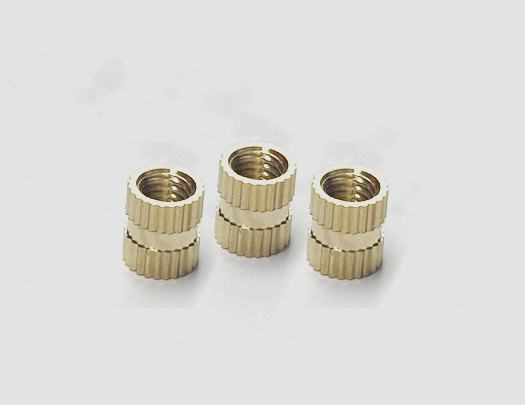
1. CNC Lathe Application for Digitalization Upgrade: Achieves single-setup machining of outer diameters, inner bores, and threads, boosting processing efficiency by 40%. Multi-axis Simultaneous Machining: Complex nuts (e.g., flanged nuts, non-standard threads) are processed using five-axis machines with precision reaching ±0.01mm. 2. Composite Machining Technology Turn-Mill Machines: Integrated turning, milling, and drilling capabilities reduce setup changes, ideal for irregular nut processing. Laser-Welded Nuts: Used for automotive lightweighting by bonding nuts to thin plates, boosting strength by 20%. 3. Intelligent Production Online Inspection System: Real-time monitoring of thread mean diameter via laser sensors enables automatic adjustment of machining parameters.
2025
-
09
-
04
What are the fundamental processes for precision mechanical part machining? (I) Process Benchmarks Process benchmarks refer to the reference points employed during a part's machining process. Based on their function, these benchmarks can be categorized as: - Process benchmarks - Positioning benchmarks - Measurement benchmarks - Assembly benchmarks 1. Process Benchmark In a process diagram, the reference point used to determine the dimensions, shape, and position of a machined surface after processing is called the process benchmark. 2. Positioning Reference: The reference used during machining to determine the correct position of the workpiece on the machine tool or in the fixture is called the positioning reference. 3. Measurement Reference: The reference used during or after machining to measure the shape of the workpiece is called the measurement reference.
2025
-
09
-
04
In modern automotive manufacturing systems, the stamping process plays a crucial role. As one of the core technologies for producing automotive components, stamping transforms sheet metal into various precision parts, providing a solid foundation for vehicle production. The essence of stamping lies in applying pressure to sheet metal using dies, inducing plastic deformation to achieve components with the desired shape and dimensions. While seemingly straightforward, this process involves intricate technical expertise. From the initial selection of raw materials, multiple factors must be considered, including the metal's mechanical properties, formability, and surface quality. Common stamping materials include cold-rolled steel sheets,
   Total:14  Total Pages:3 | Page1  9First Page   7Previous   Next8   Last Page:  Jump